Hi, I have a question regarding the folded peaks in N15-HSQC. So I am going to assign the spectra with 3D spectra which all recorded at 20ppm spectra width, and also my N15-HSQC is recorded at 20ppm spectral width. But if I set aliasing to my folded peak in 15N-HSQC, will it affect the assignment using 3D spectra? And why I cant see the real position of the folded peak after set aliasing to the peaks in HSQC?
So in principle doing your assignment like this should be fine. I was expecting that when you set the aliasing for a peak (e.g. using right-click / Set Aliasing… ), then you should see the spectrum reproduced (with peaks at their real location shown normally and in aliased positions opaquely).
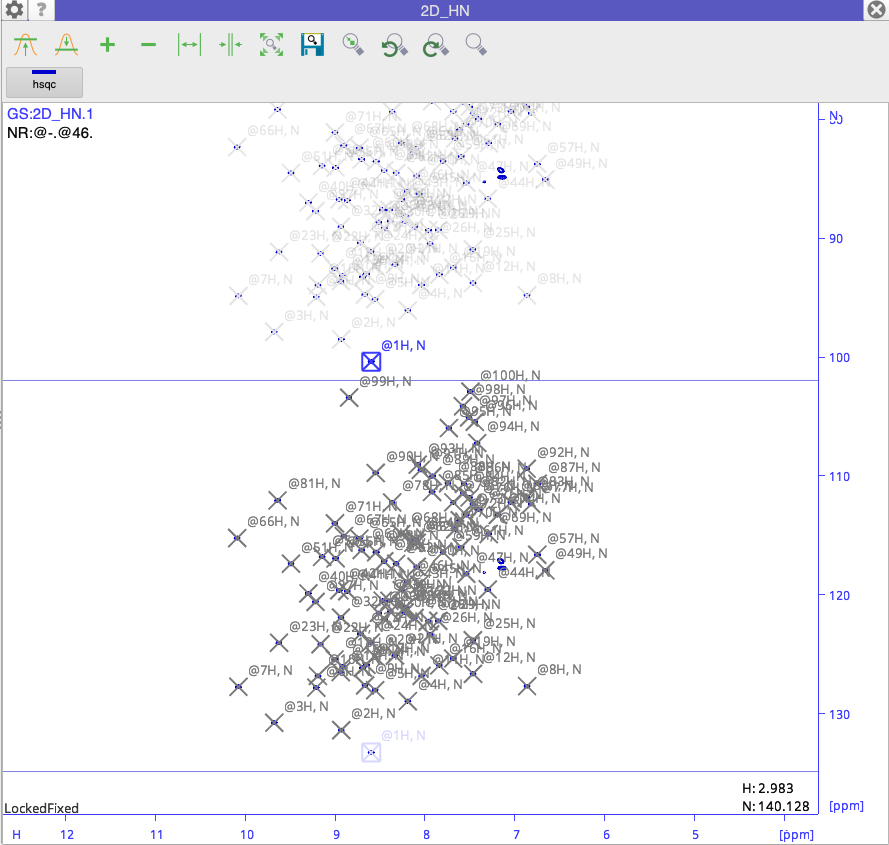
But when I tried this out, it didn’t happen automatically. It looks like there is a bug that crept in there. I’ll make sure we get that fixed.
However, you can always go to the Spectrum Properties of any spectrum and in the Dimensions tab you can set the Aliasing Limits manually:
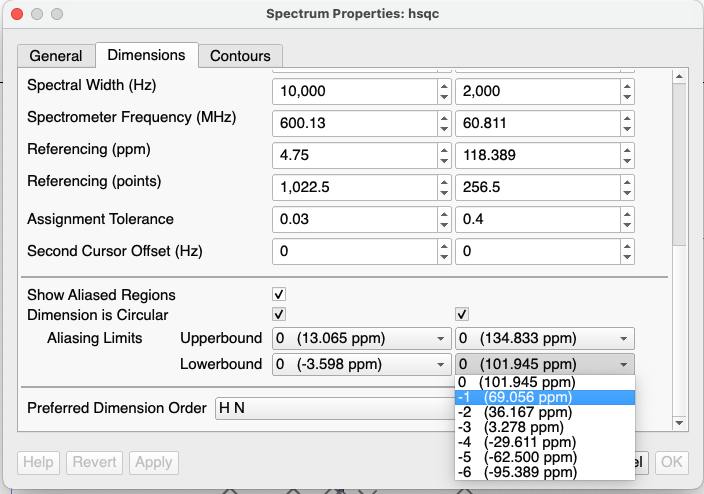
Not as convenient, obviously, but helpful until we fix this bug.
I would suggest that you expand the Aliasing Limits for all your assignment spectra, so that you can see peaks at their correct position from the start, regardless of whether you have placed an aliased peak in that spectrum yet or not.
Vicky
Hi Vicky,
thank you for your comment. But if I set aliased peaks in HSQC, it will be out of 20 ppm range, will it affect the residues assignment when I assign 3D spectra(which has only 20 ppm spectral width)?
Best,
Chuxin
Hi Chuxin
The key is in Vicky’s suggestion to expand the aliasing limits for your 3D spectra so that they also cover the real 15N chemical shift range. There are some subtleties though depending on how you are going to tackle the assignment process.
The “CCPN way” to do this is (if there is such a thing) would be to unalias the HSQC crosspeaks that you know are aliased, expand the 3Ds’ aliasing limits and use the restricted pick and assign process as detailed in the assignment tutorial to pick and assign the peaks at their unaliased positions. This way your 15N chemical shifts will be correct from the start and the residue type prediction algorithms will have the correct information to work with. If you don’t unalias the peaks in the 3Ds you start having strange averaged 15N shifts and the aliased peaks give rise to unreliable residue type suggestions.
If you’re feeding your data to an AI (like NMRtist, which will cope reasonably well with a mixture of aliased and unaliased peaks) or an assignment algorithm that doesn’t try to predict residue types but just focuses on connections between NMRresidues/spin systems, it would be fine to do everything within the narrow fixed 15N sweep widths. You will need to unalias the peaks eventually though to get the correct 15N shifts. This is not hard to do either via the CCPN GUI or with a script.
Let us know which way you decide to go!
Brian
Hi Brian,
thank you for the explanation. I decide to go both ways. I already used NMRtist to do the assignment by feeding it 3D spectra and HSQC in which some peaks are aliased, and it reached accuracy of 94% which seems nice. And now after unaliasing in HSQC and expanding 3D spectra’s aliasing limits I am in the peak picking procedure of assignment.
Best,
Chuxin