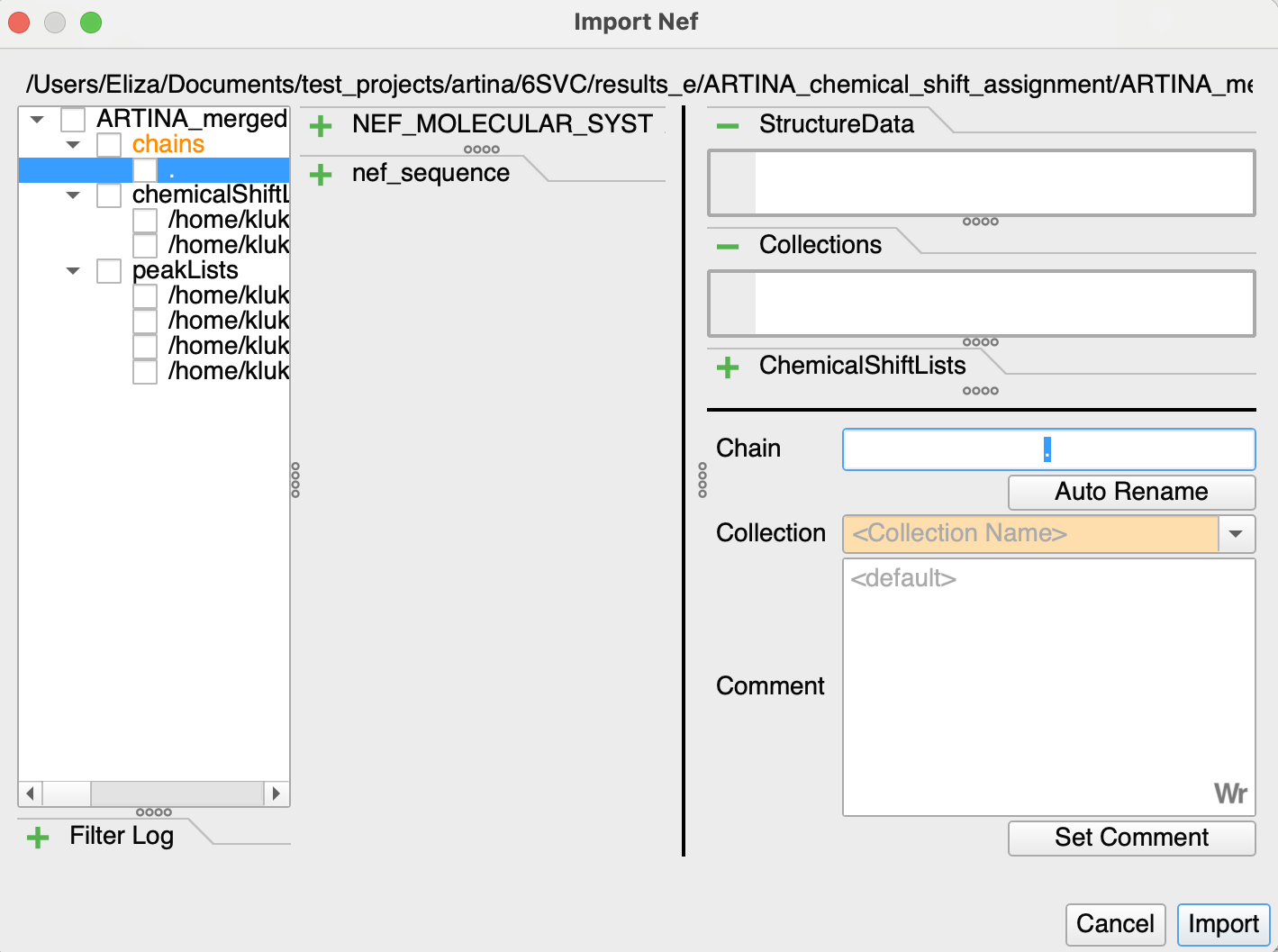
Hi Beth,
Here is the macro that should be able do that and creates a simple table (sorry quite a few lines).
Tip: use filter table (FT) option to get info that you need and you can also hide some columns.
Any questions let us know.
BW,
Eliza
"""
Compare two chemical shift lists by walking the NmrChain/NmrAtom hierarchy, flagging atoms
with shifts in both lists and reporting whether the ppm difference stays within a user-defined tolerance.
The results are exported to a project DataTable for further review.
"""
from __future__ import annotations

from collections import OrderedDict
from datetime import datetime
import re

import pandas as pd

from ccpn.ui.gui.popups.Dialog import CcpnDialogMainWidget
from ccpn.ui.gui.widgets.PulldownListsForObjects import ChemicalShiftListPulldown, NmrChainPulldown
from ccpn.ui.gui.widgets.Label import Label
from ccpn.ui.gui.widgets import Entry
from ccpn.ui.gui.widgets import CheckBox
from ccpn.ui.gui.widgets.MessageDialog import showWarning, showMessage


class CompareChemicalShiftLists(CcpnDialogMainWidget):
    title = 'Compare Chemical Shift Lists'

    def __init__(self, parent=None, mainWindow=None, title=title, **kwds):
        super().__init__(parent, setLayout=True, windowTitle=title, size=(520, 270), **kwds)

        if mainWindow:
            self.mainWindow = mainWindow
            self.application = mainWindow.application
            self.current = self.application.current
            self.project = mainWindow.project
        else:
            self.mainWindow = None
            self.application = None
            self.current = None
            self.project = None

        self._createWidgets()

        self.setOkButton(text='Compare', callback=self._compareLists,
                         tipText='Create a DataTable summarising the chemical shift differences')
        self.setCancelButton(callback=self.reject)
        self.setCloseButton(callback=self.reject, tipText='Close')
        self.setDefaultButton(CcpnDialogMainWidget.CLOSEBUTTON)

    def _createWidgets(self):
        row = 0

        Label(self.mainWidget, text='Reference list:', grid=(row, 0), hAlign='right')
        self.referenceList = ChemicalShiftListPulldown(self.mainWidget,
                                                        mainWindow=self.mainWindow,
                                                        grid=(row, 1),
                                                        showSelectName=True,
                                                        labelText='')
        row += 1

        Label(self.mainWidget, text='Comparison list:', grid=(row, 0), hAlign='right')
        self.comparisonList = ChemicalShiftListPulldown(self.mainWidget,
                                                         mainWindow=self.mainWindow,
                                                         grid=(row, 1),
                                                         showSelectName=True,
                                                         labelText='')
        row += 1

        Label(self.mainWidget, text='NmrChain (required):', grid=(row, 0), hAlign='right')
        self.nmrChainWidget = NmrChainPulldown(self.mainWidget,
                                               mainWindow=self.mainWindow,
                                               grid=(row, 1),
                                               showSelectName=True,
                                               labelText='')
        row += 1

        Label(self.mainWidget, text='Hydrogen tolerance (ppm):', grid=(row, 0), hAlign='right')
        self.hydrogenToleranceEntry = Entry.Entry(self.mainWidget, text='0.02', grid=(row, 1), editable=True)
        row += 1
        Label(self.mainWidget, text='Heteroatom tolerance (ppm):', grid=(row, 0), hAlign='right')
        self.heteroToleranceEntry = Entry.Entry(self.mainWidget, text='0.20', grid=(row, 1), editable=True)
        row += 1

        self.onlyOutsideCheck = CheckBox.CheckBox(self.mainWidget,
                                                  text='Only report atoms outside tolerance',
                                                  checked=False,
                                                  grid=(row, 1),
                                                  hAlign='left')

    def _compareLists(self):
        reference = self.referenceList.getSelectedObject()
        comparison = self.comparisonList.getSelectedObject()

        if not reference or not comparison:
            showWarning('Missing selection', 'Please select two chemical shift lists to compare.')
            return

        if reference.pid == comparison.pid:
            showWarning('Same list selected', 'Please choose two different chemical shift lists.')
            return

        tolerances = self._parseTolerances()
        if tolerances is None:
            return

        chain = self.nmrChainWidget.getSelectedObject()
        if not chain:
            showWarning('Missing NmrChain', 'Please select an NmrChain to centre the comparison.')
            return
        rows = self._build_comparison_rows(reference, comparison, tolerances, chain)

        if not rows:
            showWarning('No overlaps', 'No atoms with chemical shifts in both lists were found.')
            return

        if self.onlyOutsideCheck.get():
            rows = [row for row in rows if not row['WithinTolerance']]
            if not rows:
                showWarning('No differences', 'All atoms fall within the supplied tolerance.')
                return

        df = pd.DataFrame(rows)
        safe_name = re.sub(r'[^A-Za-z0-9_]+', '_', f'{reference.name}_{comparison.name}')
        timestamp = datetime.now().strftime('%Y%m%d_%H%M%S')
        table_name = f'CSComparison_{safe_name[:40]}_{timestamp}'
        comment = (f'Comparison between {reference.name} and {comparison.name} with '
                   f'hydrogen {tolerances[0]:.4g} ppm and hetero {tolerances[1]:.4g} ppm tolerances.')

        try:
            self.project.newDataTable(name=table_name, data=df, comment=comment)
        except Exception as exc:
            showWarning('Creation failed', f'Unable to create DataTable: {exc}')
            return

        showMessage('Comparison ready', f'DataTable "{table_name}" now holds the comparison.')
        return self.accept()

    def _parseTolerances(self):
        try:
            hydrogen_tol = float(self.hydrogenToleranceEntry.get() or 0)
            hetero_tol = float(self.heteroToleranceEntry.get() or 0)
        except ValueError:
            showWarning('Invalid tolerance', 'Tolerance must be a valid number (ppm).')
            return None

        if hydrogen_tol < 0 or hetero_tol < 0:
            showWarning('Invalid tolerance', 'Tolerances must be zero or positive.')
            return None

        return hydrogen_tol, hetero_tol

    def _build_comparison_rows(self, reference, comparison, tolerances, chain_filter):
        """Collect rows for atoms that exist in either of the selected chemical shift lists."""
        hydrogen_tol, hetero_tol = tolerances
        entries: dict[object, dict] = {}

        def _consider(shift_list, label):
            for shift in shift_list.chemicalShifts:
                atom = shift.nmrAtom
                if not atom or not atom.nmrResidue:
                    continue
                nmr_chain = atom.nmrResidue.nmrChain
                if chain_filter and (not nmr_chain or nmr_chain.pid != chain_filter.pid):
                    continue
                entry = entries.setdefault(atom, {'atom': atom, 'residue': atom.nmrResidue, 'chain': nmr_chain, 'shifts': {}})
                entry['shifts'][label] = shift

        _consider(reference, 'reference')
        _consider(comparison, 'comparison')

        rows = []
        ref_label = reference.name
        cmp_label = comparison.name

        for entry in entries.values():
            atom = entry['atom']
            residue = entry['residue']
            shifts = entry['shifts']
            shift_ref = shifts.get('reference')
            shift_cmp = shifts.get('comparison')

            value_ref = shift_ref.value if shift_ref else None
            value_cmp = shift_cmp.value if shift_cmp else None

            diff = None
            within_tol = False
            tolerance = hydrogen_tol if self._is_hydrogen(atom) else hetero_tol
            if value_ref is not None and value_cmp is not None:
                diff = abs(value_ref - value_cmp)
                within_tol = diff <= tolerance

            lists = sorted({cs.chemicalShiftList.name for cs in atom.chemicalShifts if cs.chemicalShiftList})
            all_lists = ', '.join(lists)

            row = OrderedDict()
            row['ResiduePid'] = residue.pid if residue else ''
            row['SequenceCode'] = residue.sequenceCode if residue else ''
            row['ResidueType'] = residue.residueType or '' if residue else ''
            row['AtomPid'] = atom.pid
            row['AtomName'] = atom.name
            row['IsotopeCode'] = atom.isotopeCode or ''
            row[f'ChemicalShiftPid ({ref_label})'] = shift_ref.pid if shift_ref else ''
            row[f'ChemicalShiftPid ({cmp_label})'] = shift_cmp.pid if shift_cmp else ''
            row[f'Shift ({ref_label})'] = value_ref
            row[f'Shift ({cmp_label})'] = value_cmp
            row['Difference (ppm)'] = diff
            row['WithinTolerance'] = within_tol
            row['ToleranceUsed'] = tolerance
            row['InReference'] = bool(shift_ref)
            row['InComparison'] = bool(shift_cmp)
            row['ShiftLists'] = all_lists
            rows.append(row)

        return rows

    @staticmethod
    def _is_hydrogen(atom):
        isotope = (atom.isotopeCode or '').upper()
        if isotope:
            return 'H' in isotope
        return atom.name.upper().startswith('H')


if __name__ == "__main__":
    popup = CompareChemicalShiftLists(mainWindow=mainWindow)
    popup.show()
    popup.raise_()
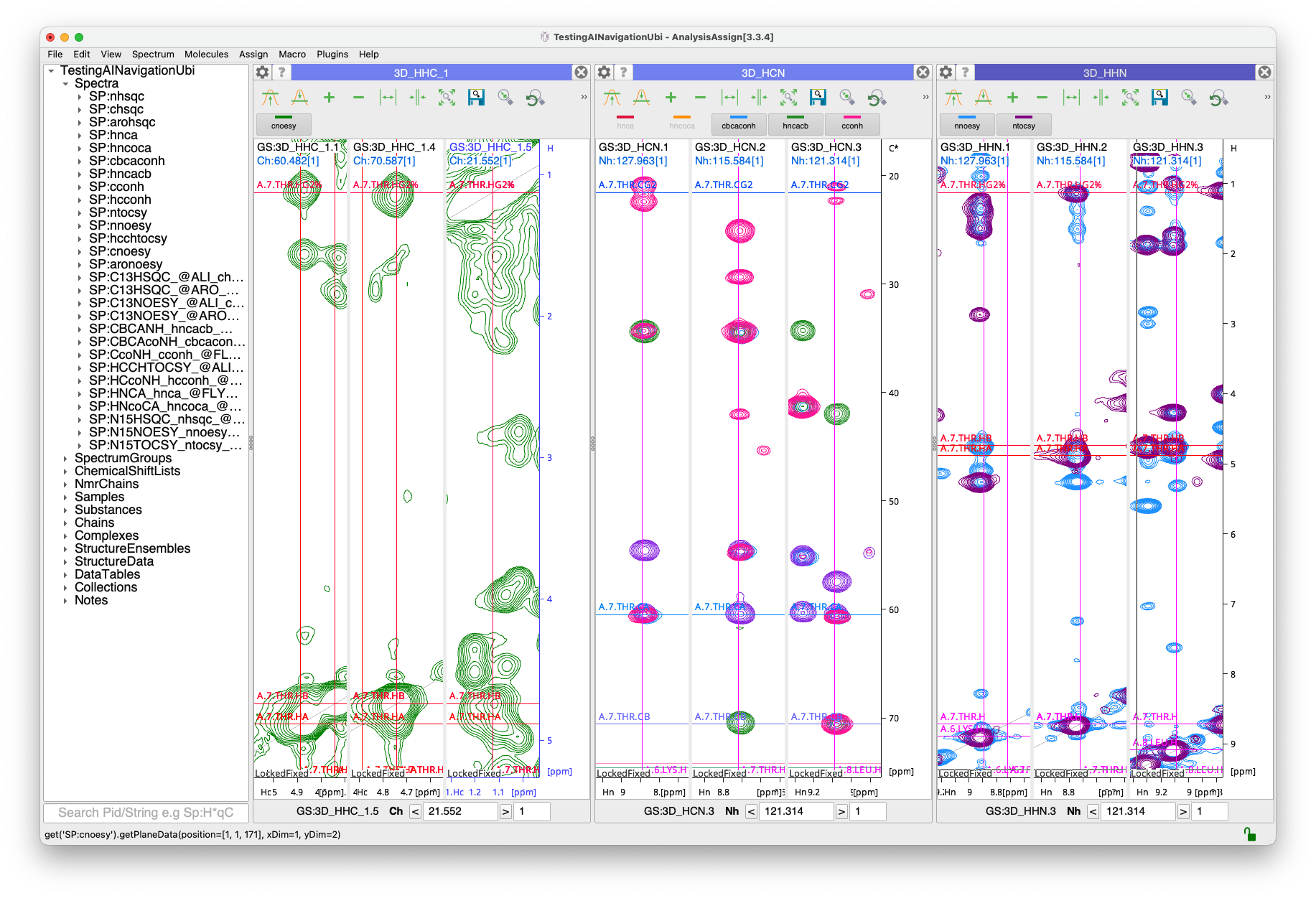
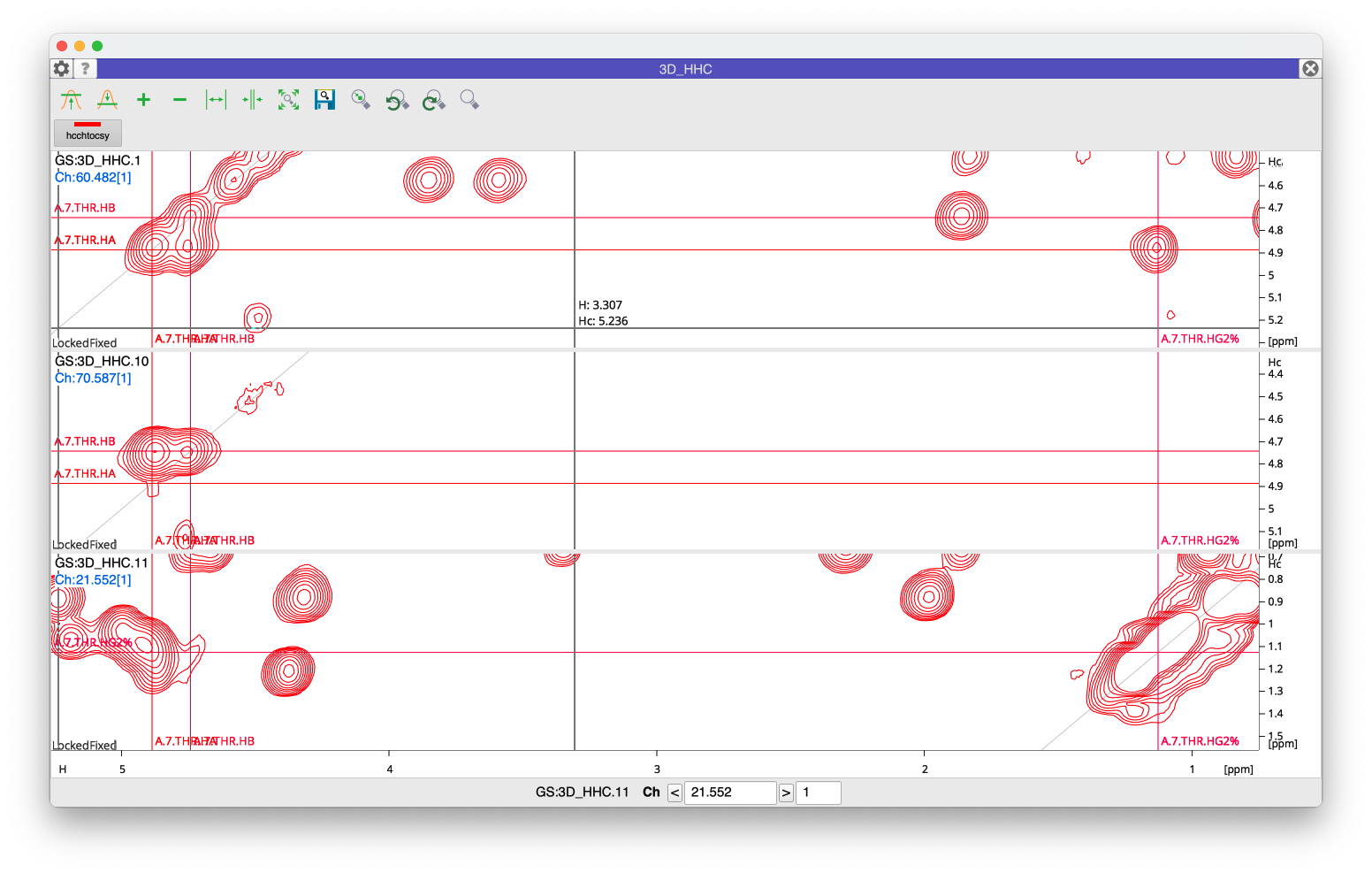
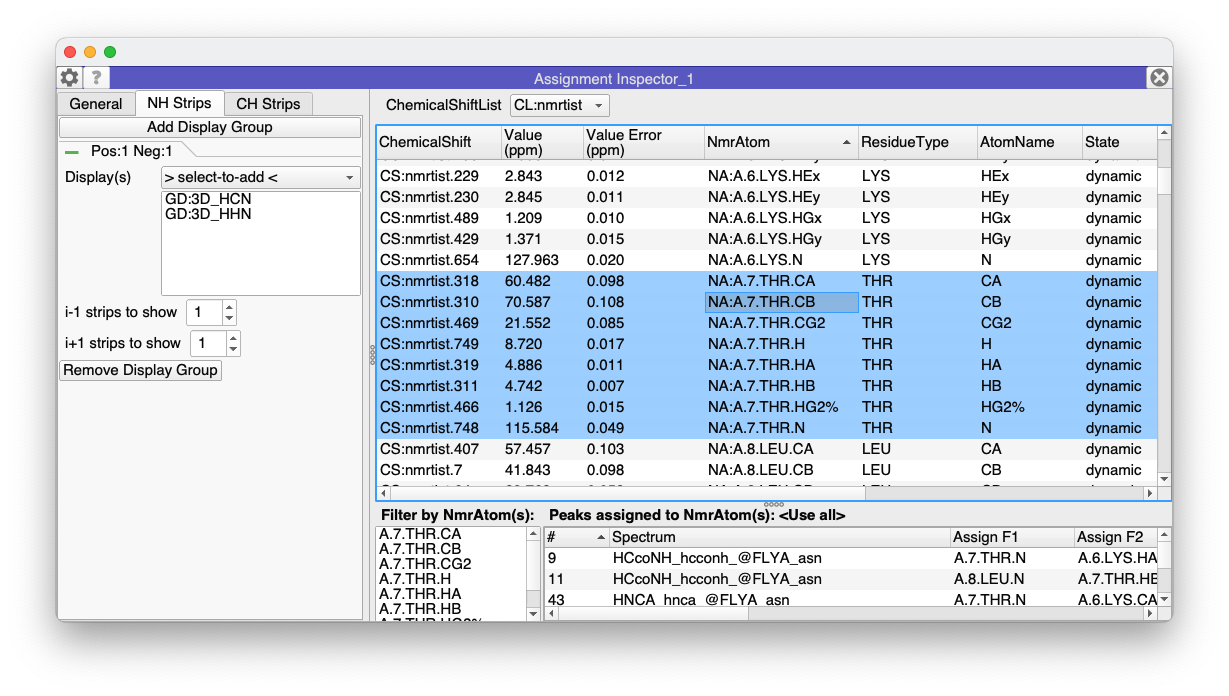
 :01227 82 7117
 :
: